
The Net Promoter® Score (NPS) is a metric of customer loyalty, as it measures the likelihood of an existing customer to recommend your business to the people that you know.
Definitions
- Net Promoter® Score: Net Promoter® Score is a metric derived by subtracting the percentage of Detractors from the percentage of Promoters. The score can therefore range from -100 to 100.
- Detractors: Patients who respond with a score of 0 - 6. These are patients unlikely to recommend your business, and at high risk of dropping out of care.
- Passives: Patients who respond with a score of 7 or 8. They likely had a fine experience, but would not be considered loyal to your brand, and would be just as likely to visit another practice. Passives are not currently displayed on the NPS Dashboard.
- Promoters: Patients with a score of 9 or 10. These patients love your practice, and are most likely to encourage people in their network to visit your practice if they are in need of care.
- Response Count: The total number of responses.
Why is the Net Promoter® Important?
NPS provides actionable insight into patient satisfaction, loyalty, and overall experience. It helps us to:
- Identify areas for improvement in our services
- Track patient sentiment over time
- Quickly follow up with unhappy patients to resolve concerns
- Celebrate successes and positive feedback with our teams
- Benchmark our practice against industry standards
How is the Net Promoter® Score Measured / Calculated?
The Net Promoter Score is calculated by subtracting the percentage of Detractors from the percentage of Promoters.
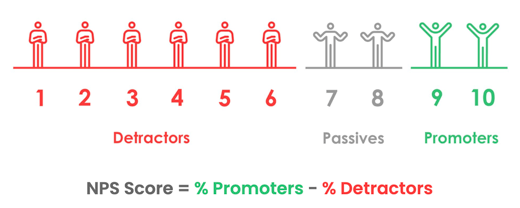
NPS scores range from -100 to +100, with higher scores indicating greater patient loyalty.
The key is to calculate your NPS regularly and use it as a benchmark for continuous improvement. If your score rises, it’s a sign to keep up the great work and keep optimizing your processes. If it falls, it’s a clear signal to address issues before losing more patients.
Note: The NPS Dashboard only shows your Promoter and Detractor percentages, and the total number of responses for the purposes of the calculation.
What is a good NPS score?
While NPS is used across many industries, healthcare typically scores higher due to personalized patient care. Based on industry benchmarks for physical therapy:
|
NPS Score |
Meaning |
|
75 or above |
Excellent |
|
50 to 74 |
Good |
|
30 to 49 |
Opportunity for Improvement |
|
Below 30 |
Poor and cause for concern |
Understanding & Taking Action with NPS Feedback
Because NPS surveys collect meaningful, real-time feedback, this information allows us to course correct early—before small issues become major problems.
- Promoters: Ask for referrals and maintain contact to support their ongoing therapy needs.
- Passives: Ensure patients are paired with therapists best suited to their needs. Consider adjusting the therapy plan if the patient feels progress has stalled.
- Detractors: Identify early warning signs of dropout, pinpoint problem areas, and adjust clinical or operational workflows as needed. Implement a real-time service recovery process to address concerns promptly.
See the article on responding to feedback for detailed guidance on following up with patients based on their feedback.
How often should I be reviewing NPS feedback?
NPS feedback should be reviewed weekly to stay on top of patient experience trends and identify opportunities for improvement. However, any low score (Detractor response) should be addressed within 24–48 business hours to ensure timely follow-up and service recovery.
Can I be alerted when a score is submitted?
Yes, in Second Door, users can be alerted when a score is submitted. You can choose to receive notifications for Detractor, Passive, Promoter scores, or any combination of the three. To customize your alerts, simply go to Settings > Profile > Notifications in Second Door and adjust your preferences.